
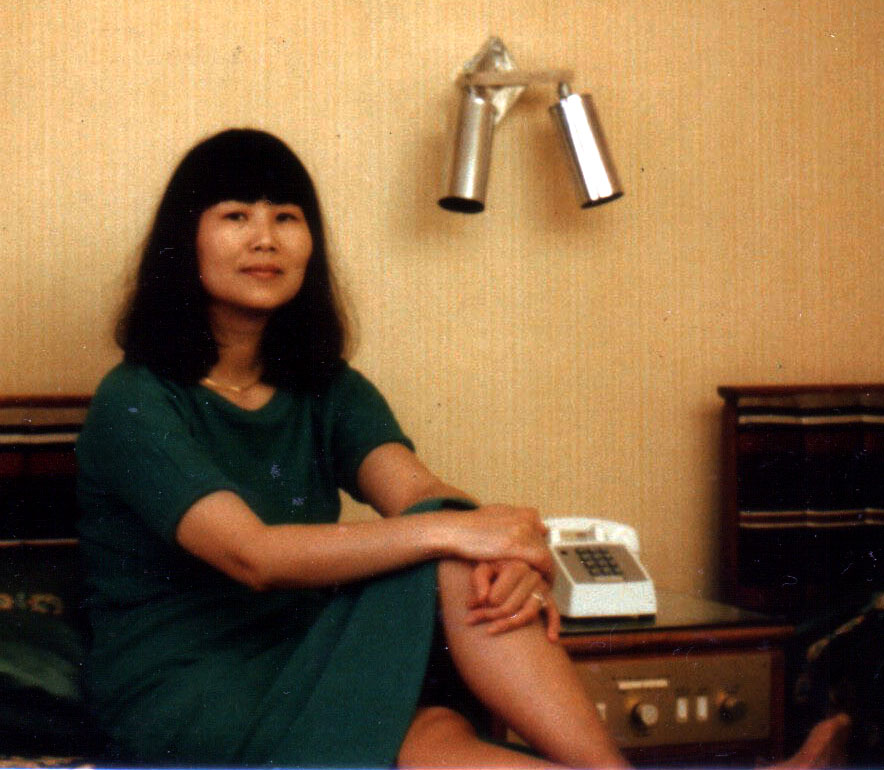
China Girl, my short story collection, is currently in queue for a late summer 2017 release. In the meantime, I’m working on another fresh project: a collection of my late mother’s travel writings titled China, Then and Now: A Travelogue. Here’s a teaser from the forward I’m writing for the project:
My mother was never one to sit still for long. She was born in Chengdu, central-west China, in 1942, and spent her formative years further east down the Yangtze River in Wuhan, before her family was forced to relocate to Taiwan in 1949 when the Communists assumed power. Her exodus wasn’t as hazardous as those of other writers who have chronicled similar journeys, but it was not without incidents and perils—at one point she masqueraded as a boy to avoid undue attention. Her story after that point reads like a case study in the American Dream: near-penniless graduate student at the University of Michigan in the early sixties, volunteer hospital stints in Detroit (the city as fearsome then as it is now), an eventual PhD in social work, a long run as a deputy commissioner in the New York State Department of Mental Health, and finally, a busy career as a health care management consultant, a gig that would take her from Ohio to New Orleans, the prisons of northern California, Tokyo and Russia.
Growing up in Albany, New York, I have vivid memories of my mother’s presence, and her absence. Once or twice a week she would take a day trip into New York City to finish up her PhD at Columbia, and looking at her face when she came home late at night, you’d never see the distances she’d traveled, the exhausting hours she’d spent. True to her Chinese roots and her current American lifestyle, she would cook a bewildering variety of dishes for dinner: Virginia fried chicken one evening, followed by traditional Chinese steamed fish with scallions the next. In person, she was as settled as any suburban mother of that era was, but her mind was always roving. She had a love of literature in all forms, something that was passed on to me in the womb—it’s been said that Mom was on a mystery-reading binge when she was pregnant with me. One of my earliest memories is looking at the rows of Rex Stout books on her shelves with juicy titles like Prisoner’s Base and The Black Mountain, gazing at those pulp-tastic covers with knives and bloody skulls and smoking revolvers, and imagining scenes, if not whole stories, around those images. Many times when I was young I would be in the room while she sat and wrote, and I didn’t mind because I was reading a book myself, both of us occupied with words on pages.
My mother had a passion for travel and cultural discovery—when I was in the womb, she was jetting off to places like San Francisco (where I live now) and London. She was a chronicler too: scrapbooks, journals, travelogues. In her two published works, she mixed a modern sensibility with clear nods to her Chinese background. Grandmother Had No Name (East Wind Press) is a study of the changing role of women in modern China which also includes a telling of her personal history (proving that you can be edifying and intimate at the same time), and The Pagoda Mystery (Minerva Press) is a historical Judge Dee-style mystery novel featuring a female protagonist that she wrote in three days. She accomplished this latter feat the same week my car was towed and my short story soundly razzed at my first grad school writing workshop; it was a cumulative blow to my ego, but it was also very funny to me (it still is). That’s Mom, making everyone else look bad.
Creatively, my mother was a hummingbird: she was industrious and hard-working, but somehow she would never quite touch down. As John Lennon would say, life happened to her while she was making other plans. If you read The Pagoda Mystery, you’ll find it to be a fun whodunit that doesn’t quite have an ending—this was often the case for many of her writing projects, in which tasty little scraps of narrative never coalesced into a finished whole. (I feel I can say this with impunity because I have also inherited this characteristic from her.) But in her travelogues, she found a perfect vehicle for her content. She was an open-minded observer: of people, of society, of difference and change. She had the ability—common to all great writers—to simultaneously engage and reflect, and the immediacy of travel inspired her. Someone I would see as just a cabbie was to her a source of cultural intel, a data bank of local knowledge, a person with a story. As an immigrant from China and Taiwan, a successful stranger in a strange land, she had a perspective about where she was from and where she was going that was unique. That perspective would find its best expression in her travel writing.
This collection spans over three decades of my mother’s journeys through China and Asia, dating back to when China was opening itself back up to the West in the late seventies. These are not the tales of a disillusioned immigrant, nor are they the musings of a thoroughly “Americanized” soul encountering an alien culture for the first time. These are the chronicles of a nation in transition, from the point of view of a woman who has experienced the best and worst of both East and West, someone who stood both inside and outside modern China. In the stories of urban dwellers, long-lost relatives, and sometimes cataclysmic change contained within, we bear witness to a society in flux, through my mother’s unique perspective, as she becomes reacquainted with a country that sometimes resembles the one of her childhood.
My mother passed away much too soon a few years ago, but true to her practical nature, she remained calm and philosophical to the end. Perhaps she was content in the notion that she did everything she set out to do. She had traveled the world; she had found happiness in work and family; and she had been a chronicler. A few weeks before her passing she visited Ireland, homeland of James Joyce, for the first time. She concluded her travelogue, the last bit of writing in her life, thus:
One’s mind and spirit can carry one to a place where there is no pain, no fatigue, and no illness, but lots of small discoveries. Most of all, it’s the realization that the world has gone on for centuries by itself, with others involved in the changes, no thanks to you. You are at once insignificant and an important witness to a world outside your sphere of experience. Yet even the exotic can be familiar, for human experiences share more similarities at their core. The exchanges with other scholars, and strangers you meet on the road, are more precious because you would not have had the experience without the trip, and your understanding is thus enriched. I leave with appreciation and gratitude, carrying this glow of shared humanity all the way back home.
Her mission in life was to witness, to document—and it is also our mission, as writers. I hope you enjoy her everlasting reportage from Asia.
— Ho Lin, 2017